Call us now to talk through your vacation options!
- USA & Canada Toll-Free
1877 298 7205 - UK FreeFone
0800 096 9438 - International
+353 69 77686

Scenic Attractions in Ireland

Carrick-a-Rede Rope Bridge
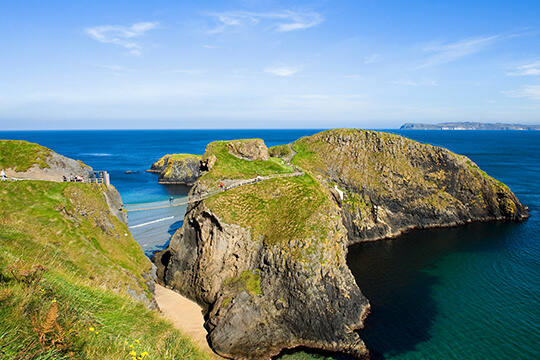
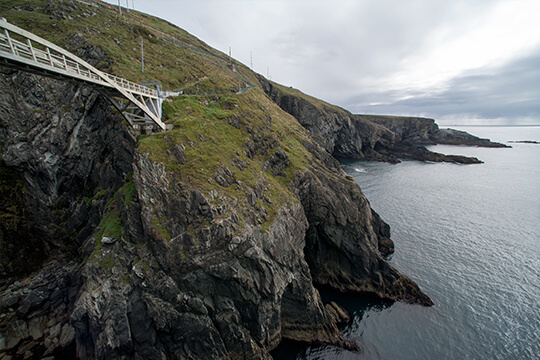
Carrick-a-Rede Rope Bridge is a rope suspension bridge near, Ballintoy, County Antrim, Northern Ireland. The bridge links the mainland to the tiny Carrick Island. The site is owned and maintained by the National Trust, spans twenty metres and is thirty metres above the rocks below. Today the bridge is mainly a tourist attraction, with 227,000 visitors in 2007. The bridge is now taken down every year in late October or early November, depending on weather conditions, having been put up in March. Carrick-a-rede means 'rock in the road'. It is thought salmon fishermen have been erecting bridges to the island for over 350 years. It has taken many forms over the years. In the 1970s it featured only a single handrail and large gaps between the slats. A version of the bridge, tested up...read more

Giants Causeway
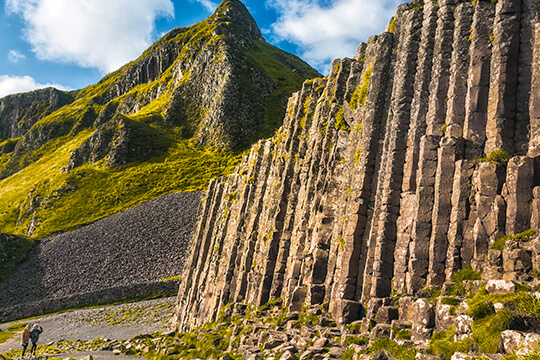
The Giant's Causeway (or Irish: Clochán na bhFómharach) is an area of about 40,000 interlocking basalt columns, the result of an ancient volcanic eruption. It is located on the northeast coast of Northern Ireland, about two miles (3 km) north of the town of Bushmills. It was declared a World Heritage Site by UNESCO in 1986, and a National Nature Reserve in 1987 by the Department of the Environment for Northern Ireland. In a 2005 poll of Radio Times readers, the Giant's Causeway was named as the fourth greatest natural wonder in the United Kingdom. The tops of the columns form stepping stones that lead from the cliff foot and disappear under the sea. Most of the columns are hexagonal, although there are also some with four, five, seven and eight sides. The tallest a...read more

Glens of Antrim
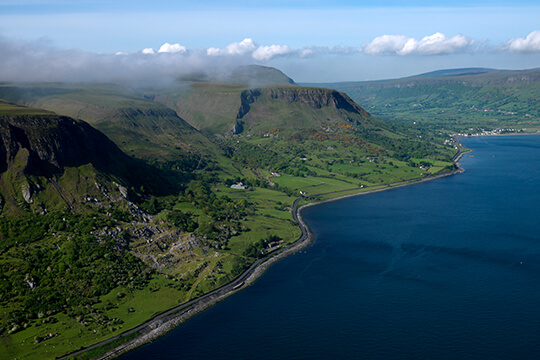
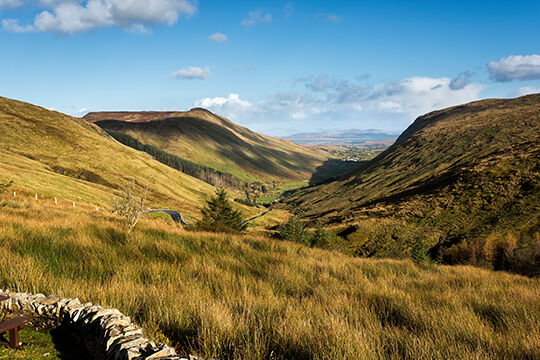
The Glens of Antrim are naturally unique - within twenty or so square miles you can enjoy a variations in natural landscape that includes glacial valleys, sandy beaches, vertical cliffs, tundra plateau, wooded glens, waterfalls and picturesque villages. Ancient sites and places of intrigue abound! Comprising nine glens, or valleys, that radiate from the Antrim Plateau to the coast. The inhabitants of the several glens are descended primarily from native Irish and Hebridean Scots. The Glens are an area of outstanding natural beauty and are a major tourist attraction in north Antrim. Principal towns in the Glens are Ballycastle, Cushendun, Cushendall, Waterfoot and Carnlough. Beginning with Glentaisie on the western side of Knocklayde, next in line of the glens comes Glenshesk on ...read more

Burren
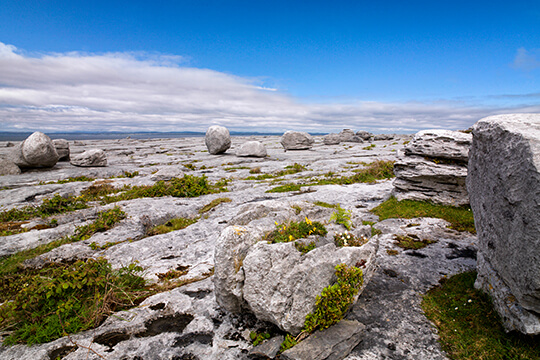
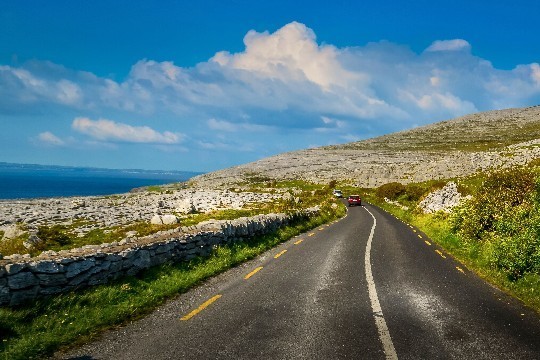
The Burren is a unique karst-landscape region in northwest County Clare, in Ireland and one of the largest Karst landscapes in Europe. The region measures approximately 250 square kilometres and is enclosed roughly within the circle comprised by the villages Ballyvaughan, Kinvara, Tubber, Corofin, Kilfenora and Lisdoonvarna, It is bounded by the Atlantic and Galway Bay on the west and north respectively. Strictly speaking the territory of the Burren or barony of Burren only contains the villages of Lisdoonvarna, Ballyvaughan, Fanore, Craggagh, New Quay/Burrin, Bealaclugga (Bellharbour) and Carron. The definite article (making it "the Burren") has only been added to the name in the last few decades, possibly by academics, as it had always been called Boireann in Irish and Burren i...read more

Cliffs of Moher
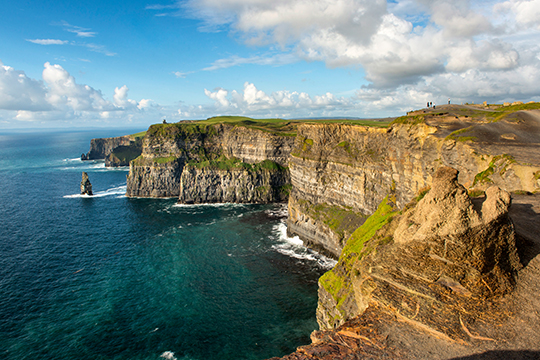
The Cliffs of Moher (Irish: Aillte an Mhothair, lit. cliffs of the ruin, also known as the Cliffs of Coher from the Irish: Mhothair) are located in the parish of Liscannor at the south-western edge of The Burren area near Doolin, which is located in County Clare, Ireland. The cliffs rise 120 meters (394 ft) above the Atlantic Ocean at Hag's Head, and reach their maximum height of 214 meters (702 ft) just north of O'Brien's Tower, eight kilometres away. The cliffs boast one of Ireland's most spectacular views. On a clear day the Aran Islands are visible in Galway Bay, as are the valleys and hills of Connemara. O'Brien's Tower is a round stone tower at the approximate midpoint of the cliffs. It was built by Sir Cornelius O'Brien, a descendant of Ireland's High King Brian Boru, in 18...read more

Aillwee Cave and the Burren Birds of Prey Centre
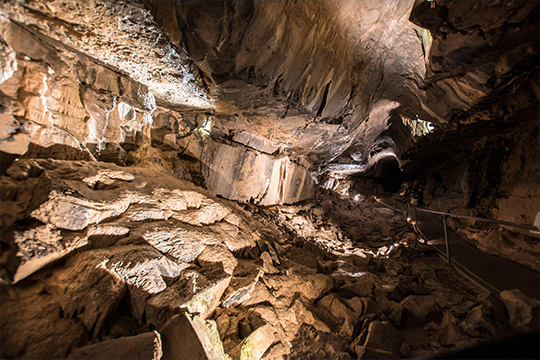
The unique karst landscape of the Burren Region is home to Aillwee Cave and the Burren Birds of Prey, located in Ballyvaughan, Co. Clare. This stunning creation of nature was formed by the melt waters of a prehistoric ice age. The cave, carved out of limestone, cuts one third of a mile into the heart of the mountains. The story of Aillwee Cave began millions of years ago when streams sinking underground on Aillwee Mountain started dissolving channels through the lines of weakness in the limestone. About one million years ago the ice age began and from then until fifteen thousand years ago Ireland's climate alternated between arctic coldness and warmer periods, freezing and melting, freezing and melting over the centuries. This melting water roared and crashed its way through the Aillwee Cave greatly enlarging the passage and bringing with it large quantities of sand and silts which are still present in the inner cave. The earliest history of the cave is preserved in its roof. Aillwee is one of the most ancient caves in the Burren and perhaps in Ireland. ...read more

Garnish Island
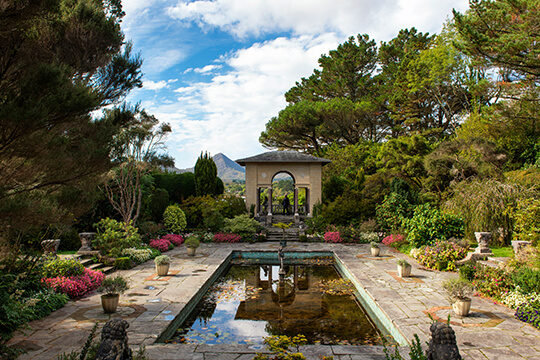
Take a short boat trip to Garinish Island, set in Bantry Bay. The island has 37 acres of gardens and is renowned for rich plant forms and varying colors, which look attractive in every season. Garinish Island is renowned for its richness of plant form and colour, changing continuously with the seasons. The vivid colours of Rhododendrons and Azaleas reach their peak during May and June, whilst the hundreds of cultivars of climbing plants, herbaceous perennials and choice shrubs dominate the midsummer period from June to August. Autumn colour, particularly on the magnificent heather bank, is rich during the usually mild early autumn months of September and October. Because of its sheltered situation and the warming oceanic influence of the Gulf Stream the climate is in some respect ...read more

Mizen Head Signal Station
Mizen Head (Irish: Carn Uí Néid), at the western extremity of the peninsula formerly known as the Ivagha Peninsula or Uíbh Eachach, is the south-westernmost point of Ireland, is one of the extreme points of the island of Ireland. It lies in west County Cork, Ireland, and is a tourist attraction. Located on the promontory are an old signalling station, a weather station, and a lighthouse. The signalling station, now a museum, is open to visitors. The "99 steps" are a long series of steps on the pathway across to the rocky outcrop upon which the station was built. The villages of Ballydehob, Goleen, and Schull are located on the peninsula. Contrary to popular belief, Mizen Head is not the most southerly point on the mainland of Ireland. Nearby Brow Head holds t...read more

Glencolumbcille
Glencolmcille or Glencolumbkille is a coastal town located on the southwest Gaeltacht tip of County Donegal, Ireland. Gleann Cholm Cille is still an Irish-speaking community though this is in decline; English has became the predominant language in recent years. The name translates into English as the Valley of Saint Columba. Saint Columba (Irish: Colm Cille) is one of Ireland's three patron saints (along with Saint Patrick and Saint Brigid). Colm Cille and his followers lived in the valley and the ruins of several of their churches can still be seen there. Following a dispute with the church about the right to copy religious manuscripts, Colm Cille went into exile on the isle of Iona off the west coast of Scotland. Between 4000 and 3000 BC, farming people settled in the area and ...read more

Inishowen 100
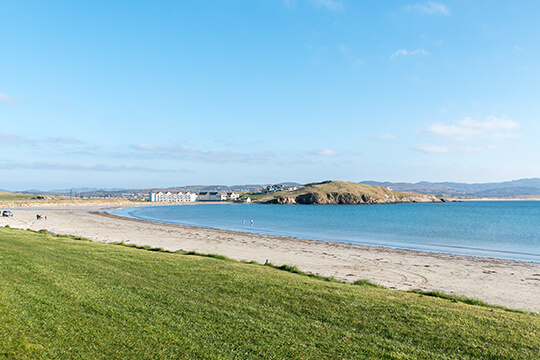
The Inishowen 100 gets its name from the approximate distance in miles of the signposted drive, which officially starts in Bridgend on the Inishowen Peninsula. Inishowen is a peninsula of 884.33 square kilometres (218,523 acres), situated in the northernmost part of Ireland. It is bordered to the north by the Atlantic Ocean, to the east by Lough Foyle, and to the west by Lough Swilly. It is joined at the south to the rest of County Donegal, the part known as Tír Conaill, and by County Londonderry. Historically, the area of Derry west of the River Foyle also forms part of Inishowen, the Foyle forming a natural border. Most of Inishowen's population inhabit the peripheral coastal areas, while the interior consists of low mountains, mostly covered in bogland, the highest of ...read more

Malin Head
Malin Head (Irish: Cionn Mhálanna) is the most northerly headland of the mainland of Ireland (and of Ulster. It is not in Northern Ireland, though more northerly than any part of it.) The most northerly point is actually a headland 2 km northeast of Malin Head, Inishowen Peninsula, County Donegal. It lies at latitude 55.38ºN. Malin Head gives its name to the Malin sea area. The weather station at Malin Head (built 1955) is an important element of the Irish meteorological service Met Éireann, providing weather reports. and plays its part in the official Weather Forecasts. The Irish Marine Emergency Service, based at the radio station, has a major role in the safety of life at sea. Banba's Crown on Malin Head is Ireland's most northerly point.Banba was one of the...read more

Slieve League
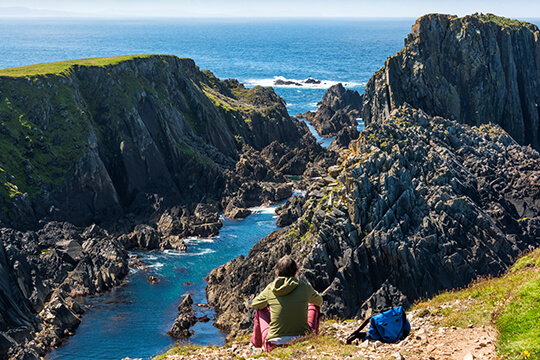
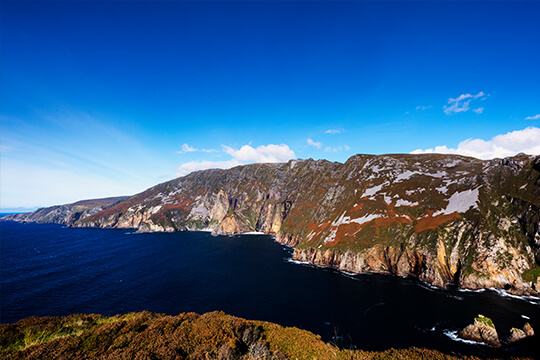
Sliabh League cliffs, situated on the southwest coast of Donegal, are said to be the highest and one of the finest marine cliffs in Europe. To fully enjoy the spectacle of Sliabh League it is best to leave your car at the car park and walk the few miles to the cliffs so as not to miss the exciting scenery of the area. There are terrific views of the Atlantic Ocean, the Sligo Mountains and Donegal Bay as you walk towards the terrifyingly high top of Sliabh Liag where the cliff face of Bunglas rises over 600m above the raging ocean. Experienced walkers only should venture beyond the viewing point onto One Man's Pass which loops around onto the Pilgrim's Path. Drive to the fishing port of Killybegs and on to Teelin to view Slieve League sea cliffs, where the highest point reaches 1,...read more

Grand Atlantic Drive
Experience the glorious natural beauty of the Grand Atlantic Drive, which winds through Downings and Rosapenna and past golden beaches and rocky headlands. The Atlantic drive offers the visitor spectacular scenery. The Atlantic drive will bring you past Granuaile’s castle, which was once a watchtower for the famous 16th century pirate queen of Connaught. This route passes the spectacular Cathedral Rocks: water-carved cliffs that somewhat resemble a Gothic cathedral rising from the depths of the Atlantic Ocean. ...read more

Aran Islands
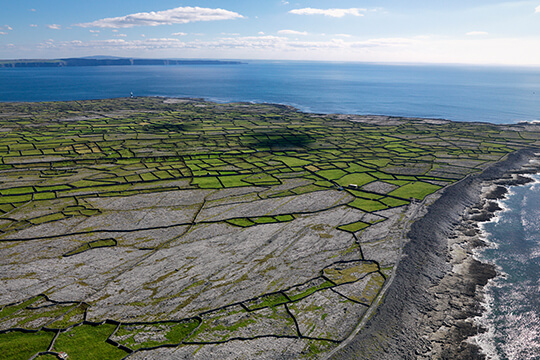
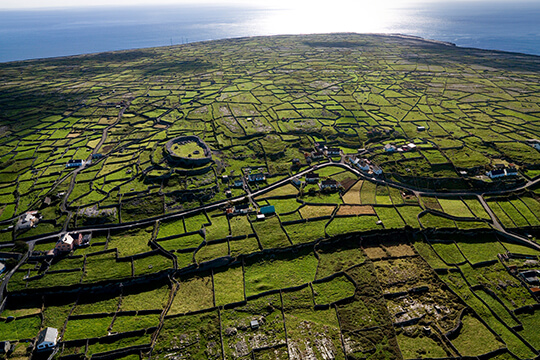
The Aran Islands are a group of three islands located at the mouth of Galway Bay, on the west coast of Ireland. The largest island is Inishmore; the middle and second-largest is Inishmaan and the smallest and most eastern is Inisheer. Irish is a spoken language on all three islands, and is the language used naming the islands and their villages and townlands. Take a short ferry ride to Inis Mor, the largest of the three Aran Islands, and island rich in the language, culture and heritage of Ireland, unique in its geology and archaeology and in its long tradition of gentle hospitality. Here is a place to sense the spirit of Gaelic Ireland, to touch the past, but with all the comforts and facilities of the present. Aran will take you back to an Ireland of Celts and Early Christians....read more

Connemara National Park
Connemara National Park (Irish: Páirc Naisiúnta Chonamara) is one of six National Parks in Ireland that are managed by the National Parks and Wildlife Service of the Department of the Environment, Heritage and local government. It is located in the west of Ireland within County Galway. Connemara National Park was founded and opened to the public in 1980. It features 29.57 square kilometres of mountains, bogs, heaths, grasslands and forests. The entrance is situated on the Clifden side of Letterfrack. There are many remnants of human civilization within the park. There is a 19th century graveyard as well as 4,000 year old megalithic court tombs. Much of the land was once part of the Kylemore Abbey estate. Western blanket bog and heathland are the most common vegetati...read more

Dun Aengus
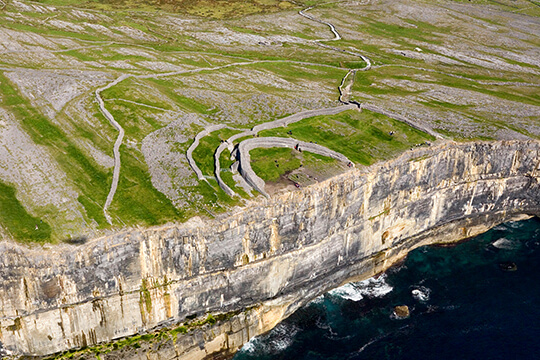
Dún Aengus is the most famous of several prehistoric forts on the Aran Islands, of Co. Galway. Ireland. It is located on Inishmore at the edge of a 100-metre high cliff. Dún Aengus is an important archaeological site that also offers a spectacular view. It was built during the Bronze Age and dates from 1,000 B.C. or before. It has been called "the most magnificent barbaric monument in Europe." The name "Dún Aengus" meaning "Fort of Aengus" refers to the pre-Christian god of the same name described in Irish mythology. The fort consists of a series of four concentric walls of dry stone construction. Surviving stonework is four metres wide at some points. The original shape was presumably oval or D-shaped but part of the cliff and fort have since collapsed into ...read more

Conor Pass
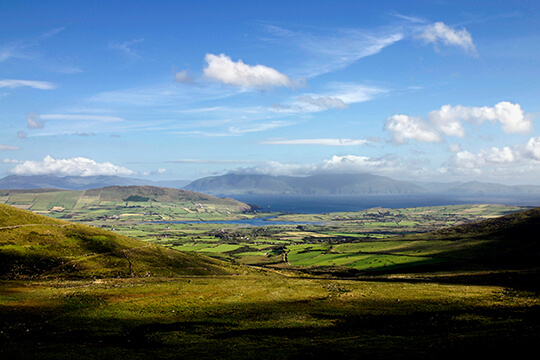
The Conor Pass is the highest mountain pass in Ireland. It is situated on the Dingle Peninsula in County Kerry, on the road that crosses the peninsula between Dingle Town and the coast the other side. The Mountains the Pass crosses are the Brandon Mountains and contain Ireland's second highest peak Brandon Mountain at 3127 ft. From Dingle Town the road runs some 4½ miles rising to 1500 ft as it winds its way to the pass. There are wonderful views of the coast. At the Pass there is a carpark where you are confronted with this magnificent sight. The road then carries on down towards Brandon Bay past cliffs, a waterfall and lakes ...read more

Dingle Peninsula
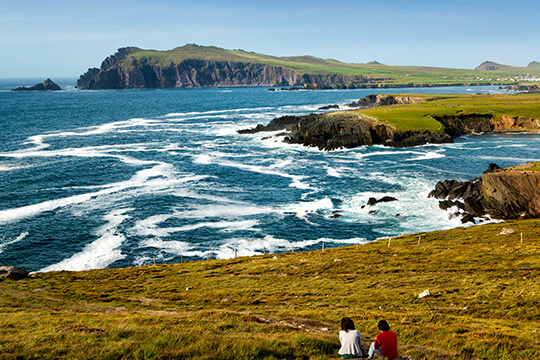
There are so many things to see, to do, to explore, to experience on the Dingle Peninsula . . . from almost 2,000 archaeological sites, to more walking than you could fit into a year, to Fungie, a bottlenose dolphin who's been living at the mouth of Dingle Harbour since 1984. There is no other landscape in western Europe with the density and variety of archaeological monuments as the Dingle Peninsula. This mountainous finger of land which juts into the Atlantic Ocean has supported various tribes and populations for almost 6,000 years. Because of the peninsula's remote location, and lack of specialised agriculture, there is a remarkable preservation of over 2,000 monuments. It is impossible to visit the Dingle Peninsula and not be impressed by its archaeological heritage. When one ...read more

Ring of Kerry
Admire breathtaking vistas of mountains, cliffs and beaches on Ireland’s most popular drive, the 100-mile Ring of Kerry. Starting from Killarney, heading around the Iveragh Peninsula and passing through Kenmare, Sneem, Waterville (favourite holiday spot of Charlie Chaplin that now has a statue of him to commemorate his love of the place), Cahersiveen and Killorglin. Popular points include Muckross House (near Killarney), Staigue stone fort and Derrynane House, home of Daniel O'Connell. Just south of Killarney, Ross Castle, Lough Leane, and Ladies View (a panoramic viewpoint), all located within Killarney National Park, are major attractions located along the Ring. The complete list of major attractions along the Ring of Kerry includes: Gap of Dunloe, Bog Village, Rossbeigh B...read more

Inis Meáin
Inis Meáin is the middle of the three main Aran Islands in Galway Bay on the west coast of Ireland. It is part of County Galway in the province of Connacht. Inis Meáin has a population of about 160, making it the smallest of the Aran Islands in terms of population. It is also quieter and less touristy than its two neighbours Inishmore and Inisheer. It is, however, one of the most important strongholds of traditional Irish culture. The island is predominantly Irish-speaking and is part of the Gaeltacht. The island is an extension of The Burren. The terrain of the island is composed of limestone pavements with crisscrossing cracks known as "grikes", leaving isolated rocks called "clints". The limestones date from the Visean period (Lower Carboniferous), formed as sediments in a...read more

Gap of Dunloe
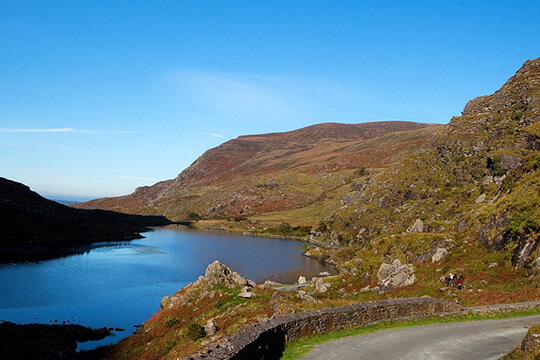
The Gap of Dunloe is a beautiful glacial valley in the Macgillacuddy Reeks mountain range, which dominate the skyline of Killarney. Here you may enjoy an energetic walk or cycle its rough path. The scenery all around the famousLakes of Killarneyis breathtaking and there are many viewing points around the lakes as you see above. The three main lakes of Killarney occupy a broad valley stretching south between the mountains. The three lakes and the mountains that surround them are all within the Killarney National Park. The Lower Lake is nearest to the town, it is studded with islands and has Muckross Abbey and Ross Castle on its eastern shore. Why not take the Gap of Dunloe Trip, by horseback or pony and trap through the Gap, and then by boat across the Killarney lake to Ross Castl...read more

Skellig Islands
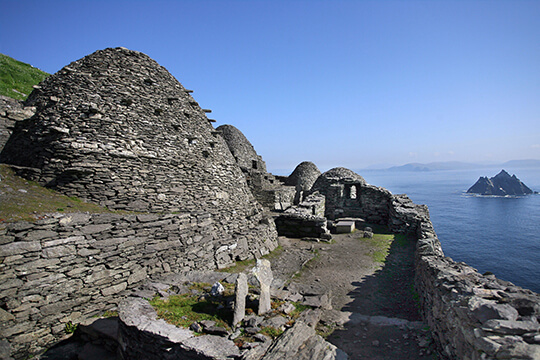
The Skellig Islands (Irish: Na Scealaga) are two small, steep and rocky islands lying about 16 km west of Bolus Head on the Iveragh Peninsula in County Kerry, Ireland. They are famous for their thriving gannet and puffin populations, and for an early Christian monastery that is a UNESCO World Heritage Site. The smaller island is Little Skellig (Sceilig Bheag in Irish). It is closed to the public, and holds Ireland's largest and the world's second-largest Northern Gannet colony, with almost 30,000 pairs. It is about 1.5 km east of Great Skellig. Also known as Skellig Michael (Sceilig Mhichíl in Irish), Great Sceilig is the larger of the two islands, rising to over 230 m above sea level. With a sixth-century Christian monastery perched on a ledge close to the top, Great Skel...read more

Valentia Island
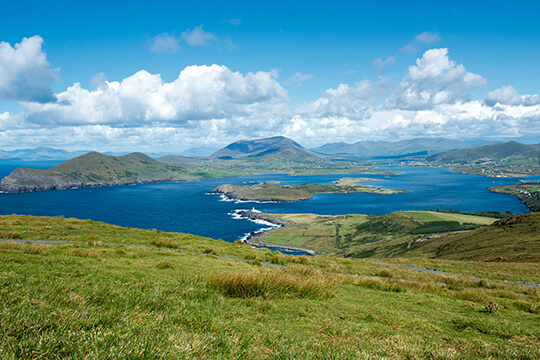
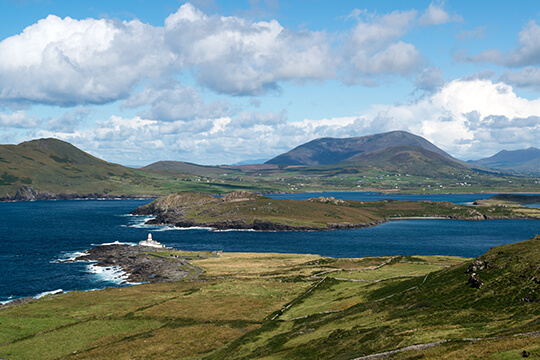
Cross to Valencia Island by bridge to visit the Skellig Experience to learn about early Christian monks who braved a harsh existence on the rocky offshore islands. Continue your trip through the remote villages of Cahirciveen and Waterville. Valentia, one of the largest islands off the South West coast of Kerry, is joined to the mainland by bridge via the Portmagee Channel. The island is one of great beauty and contrast. The western part of the island is dominated by the barren, dramatic cliffs of Bray Head which command spectacular views of the Kerry coastline while the mild effect of the Gulf Stream results in Valentia's balmy climate and lush, colourful vegetation. In The Skellig Experience Centre you can experience many aspects of the offshore Skellig islands while remaining ...read more

Croagh Patrick
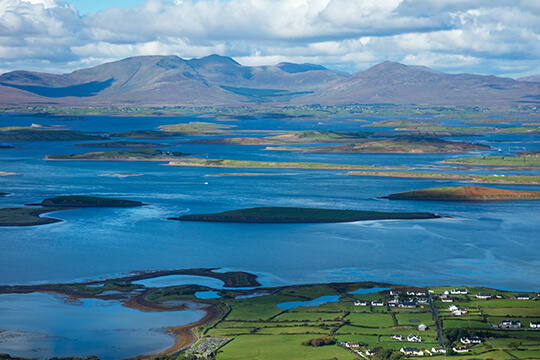
Croagh Patrick is the most prominent mountain overlooking Clew Bay on the Atlantic coast of County Mayo. Approaching it from the landward side to the east, it looks as if it has to be a holy mountain – and it is. Indeed, it is Ireland’s holiest, and one which has been attracting people to climb to its summit since the misty days of prehistory. In Ireland’s pagan period, it was probably a place where country folk for miles around foregathered to celebrate the festival of Lug, the good god of the pagan Celts, at the beginning of harvest at the turn when July turns to August. With the coming of Christianity, the Church diplomatically transformed the heathen festival into an annual Christian pilgrimage which still continues today. Called Cruachan Aigle in the earli...read more

Killary Harbour
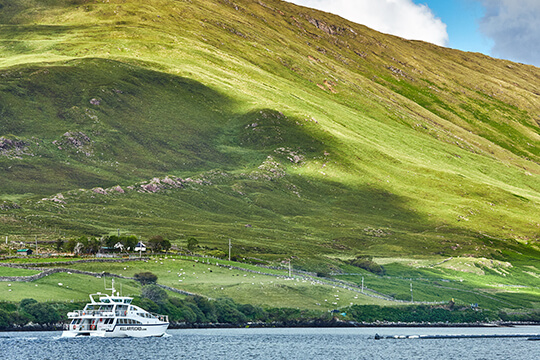
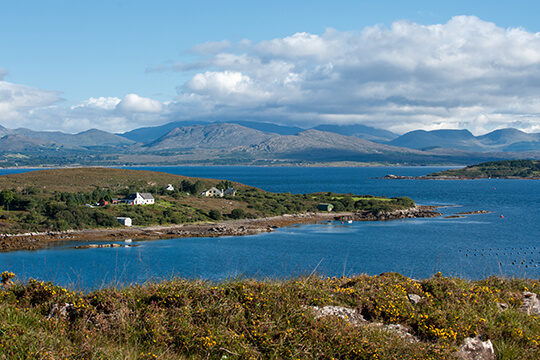
Killary Harbour / An Caoláire Rua is Ireland's only "fjord". While it is known widely as Ireland's only fjord, it is disputed that it was actually formed by glaciers. It forms a partial border between counties Galway and Mayo. It is 16 kilometres long and in the centre it is over 45 metres deep. On its northern shore lies the mountain of Mweelrea, 817 metres high. Directly opposite, on the southern, Galway side and near the mouth of the fjord, lies the hamlet of Rossroe and the former An Óige youth hostel, now disused. This building was itself converted and extended for the purpose and was formerly a modest house which was used by Ludwig Wittgenstein, the famous philosopher, as a quiet place to write shortly after World War II. A plaque to this effect was unveiled ...read more
Achill Island
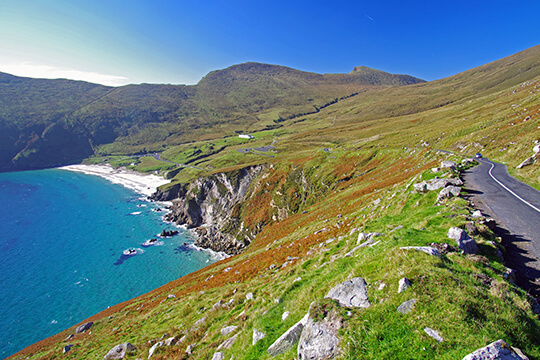
Travel across the Curraun Peninsula to reach Achill Island, joined to the mainland by bridge.The parish of Achill includes Achill Island and parts of the Currane Peninsula in County Mayo on the west coast of Ireland. This area is steeped in history and, despite its remote location, has produced or attracted a rich array of famous people and fascinating characters. The area hosts a wide variety of flora and fauna, as well as some of the most spectacular scenery in the country. With its Atlantic location, five Blue Flag beaches and breathtaking mountain landscape, Achill provides an unrivalled arena for outdoor activities and watersports of all types. Achill's romantic setting has also proved to be an inspirational creative retreat for artists and writers including Paul Henry, Hei...read more
Boyne Valley
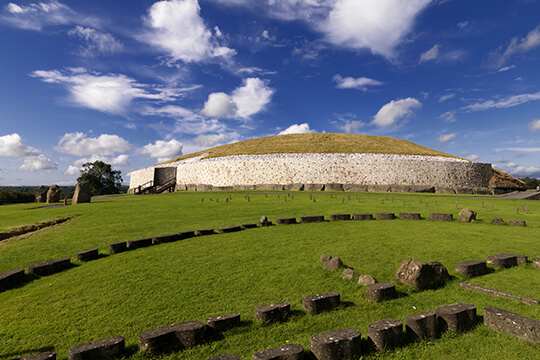
Visit the Boyne Valley Visitor Centre to learn about the burial tombs of Newgrange and Knowth, both of which are over 5,000 years old and visit one of the tombs. Newgrange was constructed over 5,000 years ago (about 3,200 B.C.), making it older than Stonehenge in England and the Great Pyramid of Giza in Egypt. Newgrange was built during the Neolithic Age by a farming community that prospered on the rich lands of the Boyne Valley. Knowth and Dowth are similar mounds that together with Newgrange have been designated a World Heritage Site by UNESCO. Archaeologists classified Newgrange as a passage tomb, however, Newgrange is now recognised to be much more than a passage tomb. Ancient Temple is a more fitting classification, a place of astrological, spiritual, religious and ceremonia...read more

Clonmacnoise
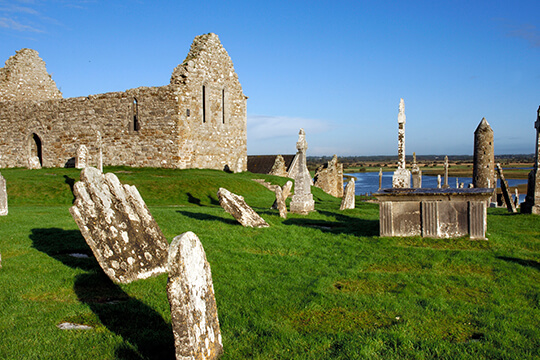
The monastery of Clonmacnoise (Cluain Mhic Nóis in Irish, meaning Meadow of the Sons of Nós) is situated in County Offaly, Ireland on the River Shannon south of Athlone. It was visited by the Pope in 1979. The site can be visited for a fee, via an Interpretative Centre. The modern village of Clonmacnoise is beside the monastery on the R444 regional road 7 km north of Shannonbridge, County Offaly. Clonmacnoise was founded in 545 by Saint Ciarán in the territory of Ui Maine at the point where the major east-west land route through the bogs of central Ireland along the Eiscir Riada, an esker or moraine left by the receding glaciers of the last ice age crossed the River Shannon. Saint Ciarán had been educated by St. Finnian of Clonard and also by Abbot ...read more

Hook Lighthouse Visitor Centre
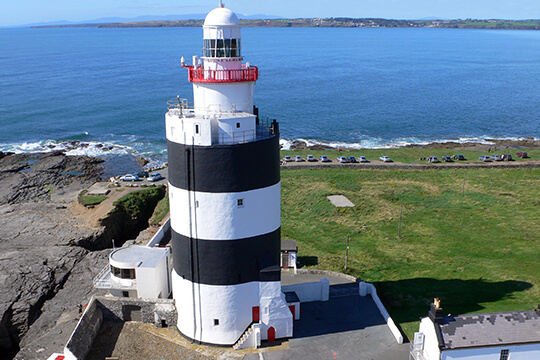
The Hook Lighthouse (also know as Hook Head Lighthouse) is situated at the tip of the Hook Peninsula in County Wexford, in Ireland, is one of the oldest lighthouses in the world. Operated by the Commissioners of Irish Lights, the Irish Lighthouse Authority, the Hook marks the eastern entrance to Waterford Harbour History The existing tower dates from the twelfth century, though tradition states that Dubhan, a missionary to the Wexford area, established some sort of beacon as early as the 5th century. The exact circumstance of the initial construction on the present structure are the subject of some controversy. It had been thought that the tower was constructed in 1172 by Raymond LeGros as part of his conquests in Ireland, both to establish the lighthouse and to serve as a fortre...read more

Glendalough
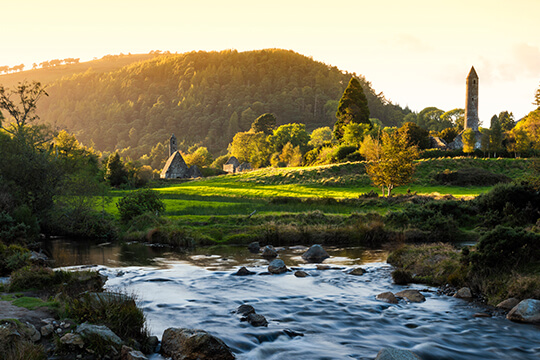
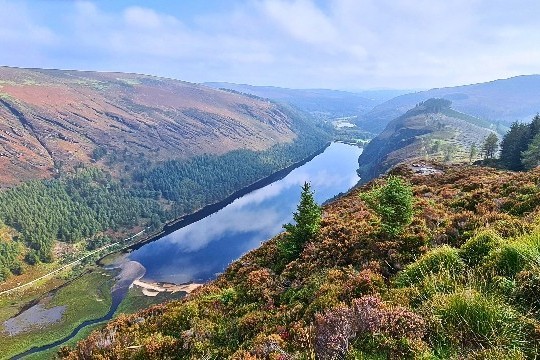
Glendalough (Irish: Gleann Dá Loch, meaning Glen of Two Lakes) is a glacial valley located in County Wicklow, Ireland, renowned for its Early Medieval monastic settlement founded in the 6th century by St Kevin, a hermit priest, and destroyed in 1398 by English troops. History of Glendalough Kevin, a descendant of one of the ruling families in Leinster, studied as a boy under the care of three holy men, Eoghan, Lochan, and Eanna. During this time, he went to Glendalough. He was to return later, with a small group of monks to found a monastery where the 'two rivers form a confluence'. His fame as a holy man spread and he attracted numerous followers. He died in about 618. For six centuries afterwards, Glendalough flourished and the Irish Annals contain references to the deat...read more

Wicklow Mountains
The Wicklow Mountains are a range of mountains in the southeast of Ireland. They run in a north-south direction from south County Dublin across County Wicklow and into County Wexford. Lugnaquilla is the highest peak in the range at 925 m (3035 ft), Mullaghcleevaun at 847 m (2,780 ft) is the second highest, while the summit of Kippure is the highest point in County Dublin, at 757 m (2,484 ft). The River Slaney has its source southwest of Lugnaquilla and then flows south along the western slopes of the mountains for some 72 km (45 mi) before entering the St George's Channel at Wexford. The Turlough Hill power station is the only pumped storage hydroelectricity scheme in Ireland; it is located on the Wicklow Gap midway between Hollywood and Glendalough. The whole area is much freque...read more

The Mourne Mountains
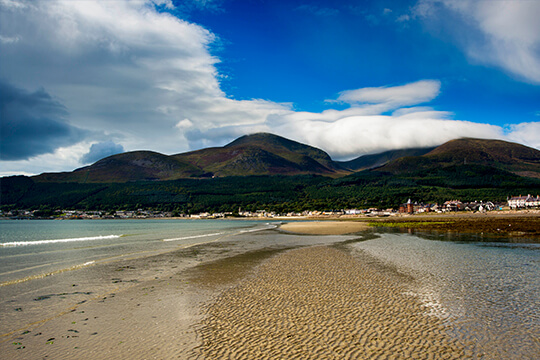
The Mourne Mountains are a granite mountain range in County Down in the south-east of Northern Ireland. It includes the highest mountains in Northern Ireland and the province of Ulster. The highest of these is Slieve Donard at 850 metres (2,790 ft). The Mournes is an area of outstanding natural beauty and has been proposed as the first national park in Northern Ireland. The area is partly owned by the National Trust and see a large number of visitors every year. The name Mourne is derived from the name of a Gaelic clann or sept called the Múghdhorna. ...read more

Ards Peninsula
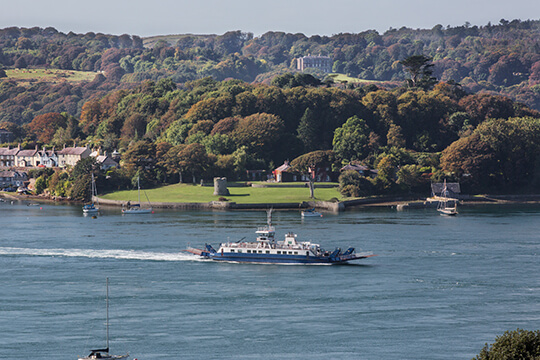
The Ards Peninsula (from the Irish: an Aird) is a peninsula in County Down, Northern Ireland which separates Strangford Lough from the North Channel of the Irish Sea, on Ireland's northeast coast. A number of towns and villages are located on the peninsula, such as the seaside town of Donaghadee, with the surrounding area known as the Ards district. Newtownards, situated at the northern end of the peninsula, is the largest town in the area, while Portaferry is at the southern end of the Peninsula. It is largely situated in the Borough of Ards. The peninsula was once known as "The Ards", and was conquered by the Normans in the 12th century, with the Norman family Savage building a number of castles, and priories on the peninsula. Towns and villages of the Ards Peninsula include: Newtownards, Portaferry, Ballyhalbert, Ballywalter, Carrowdore, Cloghy, Greyabbey, Kircubbin, Portavogie. ...read more
Call us now to talk through your vacation options!
- USA & Canada Toll-Free
1877 298 7205 - UK FreeFone
0800 096 9438 - International
+353 69 77686
Customer Testimonial
Having traveled extensively over the past 30 years, I will have to say David Yeats, our tour director, was absolutely the best! David demonstrated excellent knowledge of people, places, history, culture and music. His keen awareness and ability to connect with each person on the tour was awesome! He ensured everyone, young and old, had a wonderful time! Our trip was fabulous because of all the effort and patience David put in to it.
Jack and Lacinda Green, New York
Read more of what our customers have to say...